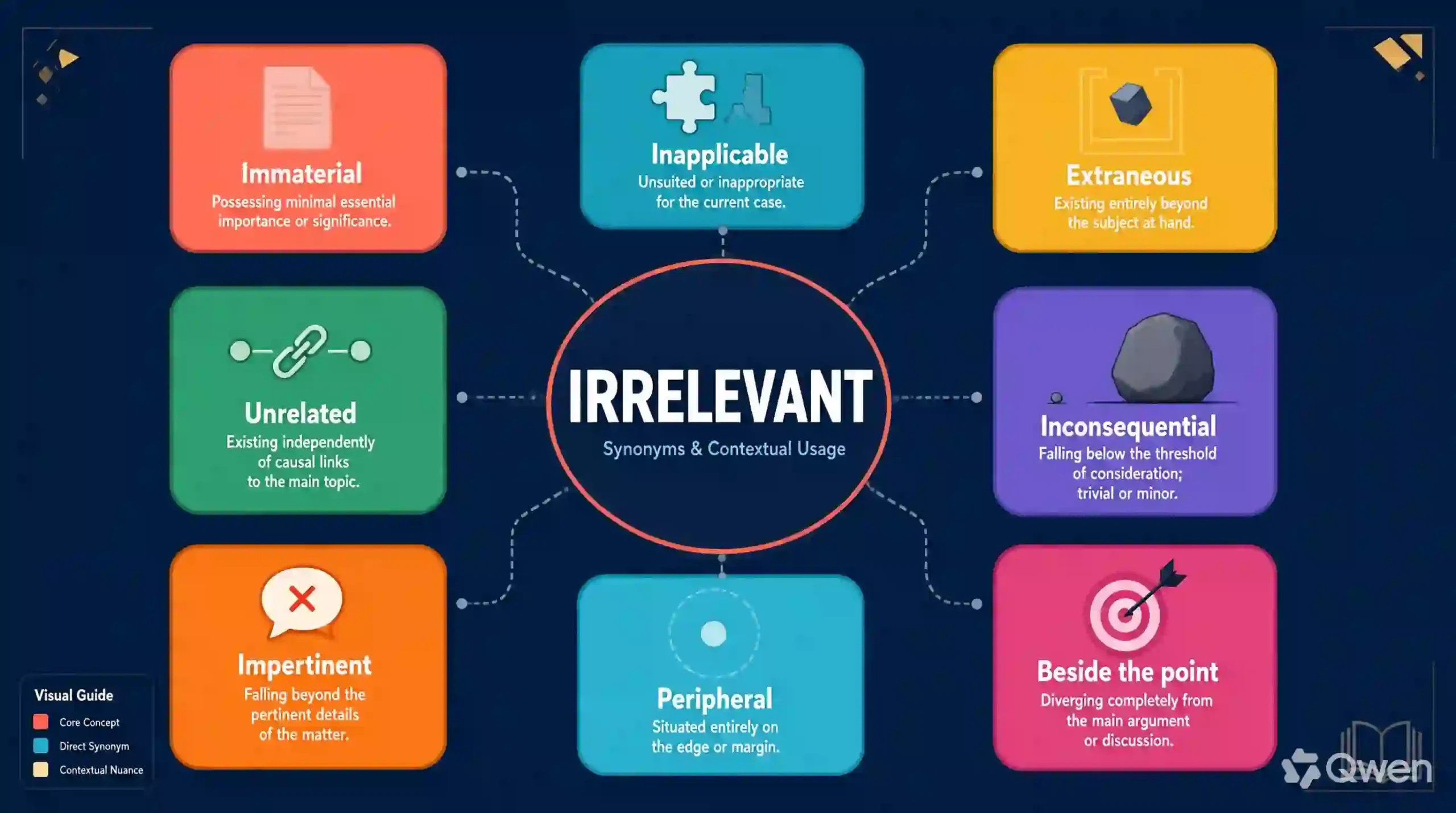
The word “irrelevant” describes something that is not related to a topic or situation. It helps us explain when information does not matter.
For example, an irrelevant detail does not help answer a question. It may confuse readers or waste time.
Learning synonyms for irrelevant helps you find better words for essays, blogs, and daily conversations.
Words like unrelated, pointless, and unimportant can make your writing clear. Students, bloggers, and writers can use them with ease.
1. Unrelated
Meaning: Unrelated means not connected to a topic or subject.
Examples:
- Your comment is unrelated to the question.
- We should avoid unrelated details in this report.
2. Irrelevant
Meaning: Irrelevant means not useful or connected to the matter being discussed.
Examples:
- That fact is irrelevant to our plan.
- Please remove irrelevant points from your essay.
3. Unconnected
Meaning: Unconnected means having no clear link with something else.
Examples:
- These two events are unconnected.
- His story seems unconnected to the main topic.
4. Immaterial
Meaning: Immaterial means not important to a decision or situation.
Examples:
- The small mistake is immaterial now.
- Your age is immaterial to this choice.
5. Inapplicable
Meaning: Inapplicable means not suitable for a certain case or situation.
Examples:
- This rule is inapplicable to our class.
- The old advice is inapplicable here.
6. Unimportant
Meaning: Unimportant means not having much value or importance.
Examples:
- We can ignore the unimportant details.
- That small issue is unimportant today.
7. Insignificant
Meaning: Insignificant means too small or unimportant to matter much.
Examples:
- The change was insignificant to the final result.
- Do not worry about an insignificant error.
8. Beside the Point
Meaning: Beside the point means not related to the main idea.
Examples:
- Your question is beside the point.
- His excuse is beside the point of our discussion.
9. Off-Topic
Meaning: Off-topic means not about the subject being discussed.
Examples:
- Please keep your comments on-topic, not off-topic.
- The class chat became off-topic after lunch.
10. Inconsequential
Meaning: Inconsequential means not important enough to change anything.
Examples:
- The delay was inconsequential to the event.
- We should not waste time on inconsequential matters.
11. Unmeaningful
Meaning: Unmeaningful means having little or no clear meaning or value.
Examples:
- The message felt unmeaningful to the readers.
- Avoid unmeaningful words in your speech.
12. Nonessential
Meaning: Nonessential means not needed for something.
Examples:
- Remove nonessential items from the list.
- We spent too much time on nonessential tasks.
13. Unnecessary
Meaning: Unnecessary means not needed or required.
Examples:
- There is no need for unnecessary details.
- The extra meeting was unnecessary.
14. Extraneous
Meaning: Extraneous means extra and not needed for the main purpose.
Examples:
- The teacher asked us to remove extraneous words.
- The report contains extraneous information.
15. Peripheral
Meaning: Peripheral means connected to the topic but not at its center.
Examples:
- We discussed a few peripheral issues.
- The story includes some peripheral characters.
16. Tangential
Meaning: Tangential means only slightly connected to the main subject.
Examples:
- His comment was tangential to the main issue.
- The article includes a tangential point about history.
17. Insubstantial
Meaning: Insubstantial means lacking enough value or importance.
Examples:
- The claim was based on insubstantial evidence.
- We need strong facts, not insubstantial ideas.
18. Trivial
Meaning: Trivial means so small or simple that it is not important.
Examples:
- They argued over a trivial matter.
- Do not let trivial problems spoil your day.
19. Minor
Meaning: Minor means small or less important than other things.
Examples:
- The report has a few minor details.
- We made a minor change to the design.
20. Negligible
Meaning: Negligible means so small that it can almost be ignored.
Examples:
- The cost difference was negligible.
- The effect of the change was negligible.
21. Inessential
Meaning: Inessential means not necessary or not needed.
Examples:
- These steps are inessential to the task.
- Leave out inessential information from the summary.
22. Nonpertinent
Meaning: Nonpertinent means not connected to the matter being discussed.
Examples:
- The lawyer objected to the nonpertinent question.
- Please remove nonpertinent facts from the file.
23. Unfit
Meaning: Unfit means not right or suitable for a certain purpose.
Examples:
- This example is unfit for the lesson.
- The old tool is unfit for this job.
24. Inappropriate
Meaning: Inappropriate means not right for a certain place or situation.
Examples:
- That joke was inappropriate for the meeting.
- The example is inappropriate for young students.
25. Out of Place
Meaning: Out of place means not suitable or not fitting in a situation.
Examples:
- His comment felt out of place during the lesson.
- The bright sign looks out of place in this room.
26. Incongruous
Meaning: Incongruous means not matching or fitting with the things around it.
Examples:
- The modern chair looked incongruous in the old room.
- His serious speech had an incongruous joke.
27. Extraneous to
Meaning: Extraneous to means not needed for or connected with a certain thing.
Examples:
- That detail is extraneous to the main question.
- The extra paragraph is extraneous to the report.
28. Not Germane
Meaning: Not germane means not closely related to the topic.
Examples:
- The point is not germane to our discussion.
- Her comment was not germane to the lesson.
29. Unrelated to the Matter
Meaning: Unrelated to the matter means having no connection with the issue at hand.
Examples:
- His personal story is unrelated to the matter.
- The extra question was unrelated to the matter.
30. Beside the Issue
Meaning: Beside the issue means not dealing with the main problem or subject.
Examples:
- That complaint is beside the issue we must solve.
- The extra detail is beside the issue in this report.
Conclusion
Learning synonyms for irrelevant helps you choose better words when writing, blogging, speaking, and sharing ideas. Words like unrelated, off-topic, unnecessary, and unimportant can make your message clearer. Remember that each word has a slightly different use. Practice them in emails, essays, and daily conversations. A little practice each day can help you build a stronger English vocabulary.