Laws are rules that help people live safely and fairly in a community or country.
The word “law” can also mean a rule made by a government or authority official.
Learning synonyms for law helps students write better essays and understand books, news, and lessons.
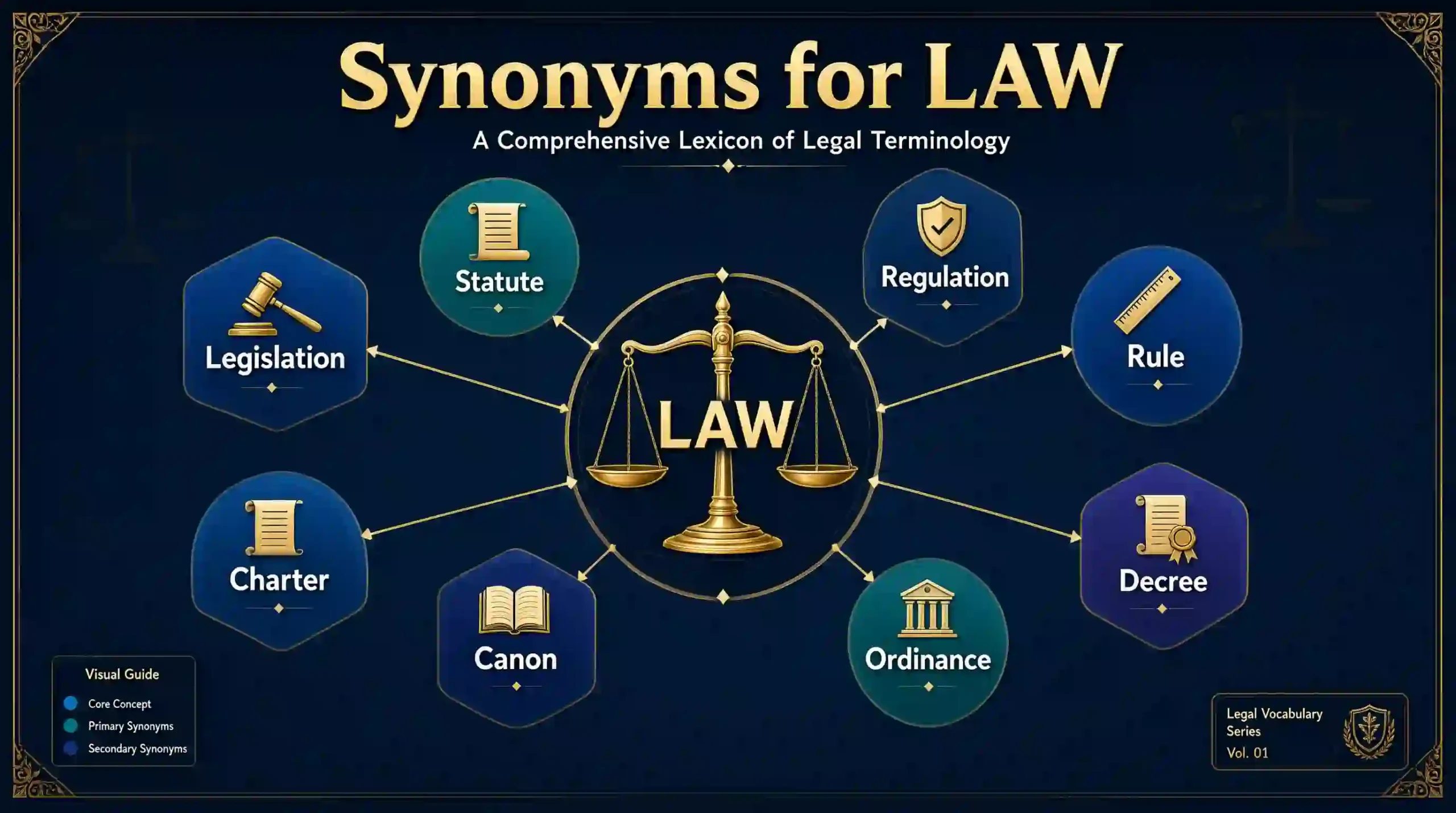
Words such as rule, regulation, statute, and legislation can make your writing clear and varied.
1. Rule
Meaning: A rule is an instruction that tells people what they can or cannot do.
Examples:
- Our school has a rule against running in the halls.
- Please follow the rules of the game.
2. Regulation
Meaning: A regulation is an official rule made by an authority.
Examples:
- The new safety regulation protects workers.
- Every shop must follow health regulations.
3. Legislation
Meaning: Legislation means laws made by a government.
Examples:
- The government passed new legislation this year.
- This legislation aims to protect children.
4. Statute
Meaning: A statute is a written law passed by a lawmaking body.
Examples:
- The statute explains the rights of local workers.
- The judge looked at the state statute.
5. Act
Meaning: An Act is a law that has been passed by a parliament or other lawmaking body.
Examples:
- The new Act protects people from unfair treatment.
- Parliament approved the education Act.
6. Ordinance
Meaning: An ordinance is an official law or rule made by a local authority.
Examples:
- The city passed an ordinance about street parking.
- A local ordinance limits noise at night.
7. Code
Meaning: A code is a set of written rules that people must follow.
Examples:
- The building code sets safety standards.
- Drivers must follow the road code.
8. Decree
Meaning: A decree is an official order made by a person or authority with power.
Examples:
- The ruler issued a decree about public safety.
- The court announced its decree yesterday.
9. Mandate
Meaning: A mandate is an official command or order that must be followed.
Examples:
- The new mandate requires safety checks.
- The school follows a mandate to protect students.
10. Commandment
Meaning: A commandment is a serious rule or order, often linked to religion.
Examples:
- The teacher discussed an important commandment.
- Many people follow this religious commandment.
11. Edict
Meaning: An edict is an official order given by a person in power.
Examples:
- The king made an edict about trade.
- The old edict changed life in the town.
12. Directive
Meaning: A directive is an official instruction that tells people what to do.
Examples:
- The manager sent a new safety directive.
- The team followed the director’s directive.
13. Policy
Meaning: A policy is a plan or set of rules used by an organization.
Examples:
- The company has a clear privacy policy.
- Please read the school’s attendance policy.
14. Principle
Meaning: A principle is a basic idea or belief that guides how people act.
Examples:
- Fairness is an important legal principle.
- The judge followed the principle of equal treatment.
15. Guideline
Meaning: A guideline is advice that helps people know how to act.
Examples:
- The office shared new safety guidelines.
- Follow the health guidelines when needed.
16. Regulation Act
Meaning: A regulation act is a law or legal measure that sets rules for an activity.
Examples:
- The regulation act covers workplace safety.
- We studied the regulation act in class.
17. Legal Code
Meaning: A legal code is a collection of laws arranged by subject.
Examples:
- The lawyer checked the legal code.
- The legal code explains how the system works.
18. Statutory Law
Meaning: Statutory law is law written and passed by a lawmaking body.
Examples:
- The case involved statutory law.
- Students learned how statutory law is made.
19. Common Law
Meaning: Common law is law developed through court decisions and legal traditions.
Examples:
- The lawyer explained how common law applies.
- Common law has shaped many legal systems.
20. Case Law
Meaning: Case law is law based on decisions made by judges in earlier cases.
Examples:
- The court reviewed case law before making its decision.
- This case law helps explain the legal issue.
21. Jurisprudence
Meaning: Jurisprudence is the study or theory of law and legal systems.
Examples:
- She enjoys reading books about jurisprudence.
- The class discussed the meaning of jurisprudence.
22. Justice
Meaning: Justice means treating people fairly and giving them what they are due.
Examples:
- The family hopes to receive justice.
- A fair court should protect justice for everyone.
23. Legality
Meaning: Legality means being allowed by the law.
Examples:
- The lawyer questioned the legality of the deal.
- We need to check the legality of this action.
24. Lawfulness
Meaning: Lawfulness means following the law and acting in a legal way.
Examples:
- The report checked the lawfulness of the decision.
- Lawfulness is important in public service.
25. Legal System
Meaning: A legal system is the set of courts, laws, and processes used in a country.
Examples:
- Every country has its own legal system.
- The students learned about the legal system.
26. Legal Framework
Meaning: A legal framework is a group of laws and rules that guide a certain area.
Examples:
- The legal framework protects workers’ rights.
- The new policy fits within the legal framework.
27. Body of Law
Meaning: A body of law is a group of laws about a subject or area.
Examples:
- The lawyer studied the body of law on contracts.
- This body of law covers family matters.
28. Statute Book
Meaning: A statute book is a collection of written laws.
Examples:
- The student found the answer in a statute book.
- The lawyer checked the statute book for details.
29. Legal Provision
Meaning: A legal provision is a part of a law that deals with a certain matter.
Examples:
- This legal provision protects young workers.
- The judge explained the legal provision clearly.
30. Enactment
Meaning: An enactment is a law that has been officially made or passed.
Examples:
- The enactment changed the rules for local businesses.
- The new enactment came into force last month.
Conclusion
Learning synonyms for law helps you improve your writing, blogging, speaking, and daily communication. Words like rule, regulation, statute, and legislation can make your sentences more clear and useful. Remember that not every synonym fits every situation. Practice these words in emails, essays, and daily conversations. With regular use, you can build a stronger vocabulary and express your ideas with confidence.