Have you ever walked into a room full of clothes and toys? Your eyes find no clean space, and your mind feels lost.
A messy desk may hide books, cups, and old papers. Each thing lies in the wrong place, and nothing is easy to find.
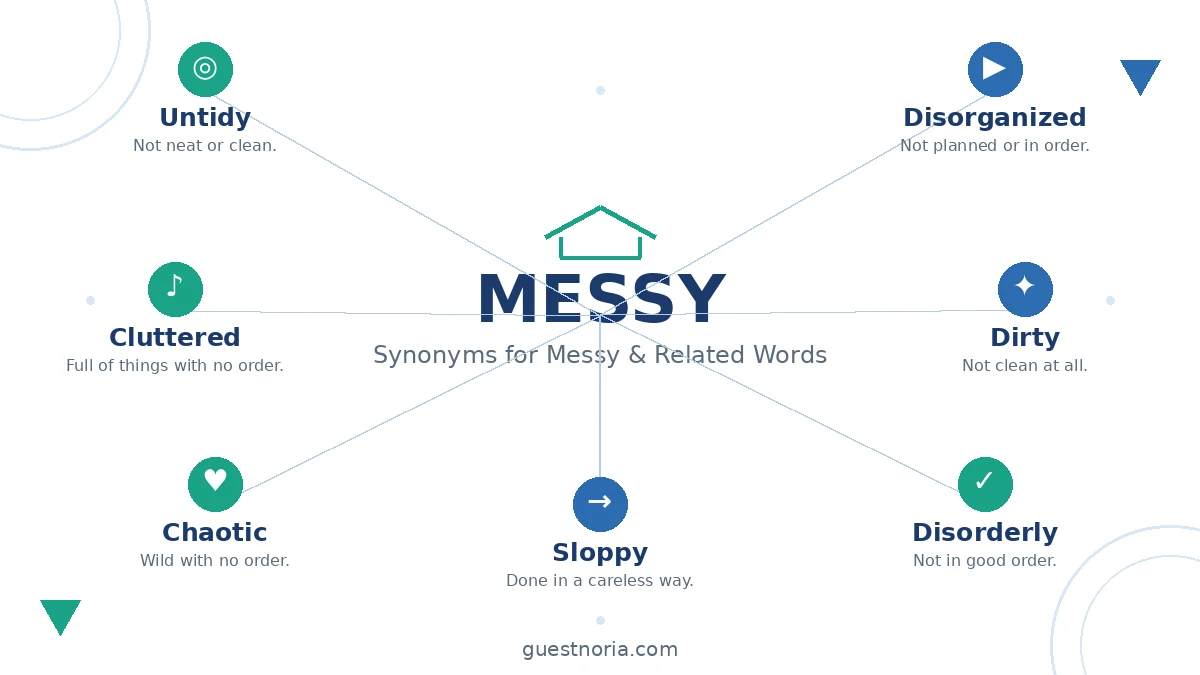
Messy means not tidy or clean. A messy place looks untidy, and a messy task feels hard to sort out.
These words help students, bloggers, writers, and daily English users. They make your speech clear and your writing fresh and exact.
1. Untidy
Meaning: Untidy means not neat or clean.
Examples:
- Her untidy room had clothes on the floor.
- His untidy desk was full of old papers.
2. Disorganized
Meaning: Disorganized means not planned or in order.
Examples:
- The disorganized trip had no map and no plan.
- Her disorganized bag held books, keys, and food.
3. Cluttered
Meaning: Cluttered means full of things with no order.
Examples:
- The cluttered shelf held books, toys, and cups.
- His cluttered room had no space to walk in.
4. Dirty
Meaning: Dirty means not clean at all.
Examples:
- The dirty floor needed a good wash and sweep.
- His dirty hands left marks on the white wall.
5. Chaotic
Meaning: Chaotic means wild with no order.
Examples:
- The chaotic fair had crowds and noise all day.
- Her chaotic day left her tired and late for tea.
6. Sloppy
Meaning: Sloppy means done in a careless way.
Examples:
- His sloppy work had ink stains on each page.
- The sloppy cook left the stove in a mess.
7. Disorderly
Meaning: Disorderly means not in good order.
Examples:
- The disorderly queue pushed and shoved at the gate.
- A disorderly room makes it hard to find things.
8. Muddled
Meaning: Muddled means mixed up and not clear.
Examples:
- His muddled notes made no sense to the class.
- The muddled plan left us all lost and late.
9. Jumbled
Meaning: Jumbled means mixed up in a heap.
Examples:
- The jumbled box held socks, wires, and old toys.
- Her jumbled words made the tale hard to hear.
10. Tangled
Meaning: Tangled means twisted into a knot.
Examples:
- The tangled wires took an hour to sort out.
- Her tangled hair needed a brush and some care.
11. Scattered
Meaning: Scattered means spread out with no order.
Examples:
- Scattered books lay on the floor all day.
- The scattered toys filled each room of the house.
12. Disheveled
Meaning: Disheveled means not neat in look.
Examples:
- His disheveled hair showed he had just woken up.
- She came home with disheveled clothes after the game.
13. Unkempt
Meaning: Unkempt means not cared for or neat.
Examples:
- The unkempt yard had long grass and dry leaves.
- His unkempt beard made him look old and tired.
14. Filthy
Meaning: Filthy means very dirty and unclean.
Examples:
- The filthy street needed a wash after the storm.
- His filthy shoes left mud on the clean floor.
15. Grubby
Meaning: Grubby means a bit dirty and not clean.
Examples:
- The grubby hands of the child left marks on glass.
- Her grubby apron showed a long day of work.
16. Messed-up
Meaning: Messed-up means in a bad and untidy state.
Examples:
- His messed-up room had books on the bed and floor.
- The messed-up plan made the trip a hard task.
17. Unclean
Meaning: Unclean means not washed or pure.
Examples:
- The unclean plates sat in the sink all day.
- An unclean well can make the whole town ill.
18. Shambolic
Meaning: Shambolic means in a state of chaos.
Examples:
- The shambolic show had no plan and late stars.
- Her shambolic desk held cups, pens, and old bills.
19. Rumpled
Meaning: Rumpled means full of creases and folds.
Examples:
- His rumpled shirt showed a long night of work.
- She smoothed her rumpled dress before the photo.
20. Tousled
Meaning: Tousled means untidy and out of place.
Examples:
- The wind left his tousled hair all over his face.
- Her tousled curls gave her a wild and fun look.
21. Straggly
Meaning: Straggly means thin and spread out.
Examples:
- The straggly plants grew in all directions at once.
- His straggly hair hung down past his ears.
22. Slovenly
Meaning: Slovenly means careless and untidy in habits.
Examples:
- The slovenly cook left pans and plates all about.
- His slovenly dress made a poor first impression.
23. Careless
Meaning: Careless means not giving enough care.
Examples:
- His careless work had faults on each page.
- A careless spill left juice on the white cloth.
24. Confused
Meaning: Confused means mixed up and not clear.
Examples:
- The confused crowd did not know where to go.
- Her confused notes made the test hard to pass.
25. Mixed-up
Meaning: Mixed-up means in a state of disorder.
Examples:
- The mixed-up files took a day to put right.
- His mixed-up plans made the trip a tough task.
26. Littered
Meaning: Littered means covered with bits of waste.
Examples:
- The littered park had cups and bags on the grass.
- A littered beach spoils the joy of a fine day.
27. Wild
Meaning: Wild means not neat or under control.
Examples:
- The wild garden had weeds in each bed and path.
- His wild hair flew in the strong wind at sea.
28. Sticky
Meaning: Sticky means covered in glue or goo.
Examples:
- Her sticky hands left marks on the door and wall.
- The sticky floor made each step a slow task.
29. Muddy
Meaning: Muddy means covered in wet dirt.
Examples:
- His muddy boots left prints on the clean mat.
- The muddy path was hard to walk on after rain.
30. Stained
Meaning: Stained means marked with dirt or spots.
Examples:
- Her stained shirt had ink spots from school.
- The stained rug needed a deep wash and clean.
Conclusion
Learning synonyms for messy makes your writing clear and your speech exact. You can describe a room, a desk, or a plan with the right word.
Try these words in emails, essays, and daily talks. Look up the full meaning of messy in the Cambridge Dictionary and use it with care every day.
Keep a small notebook of new words and read it each morning. Share what you learn with friends and family, and soon these words will feel natural in your speech. Small daily practice will make your English strong and bright.