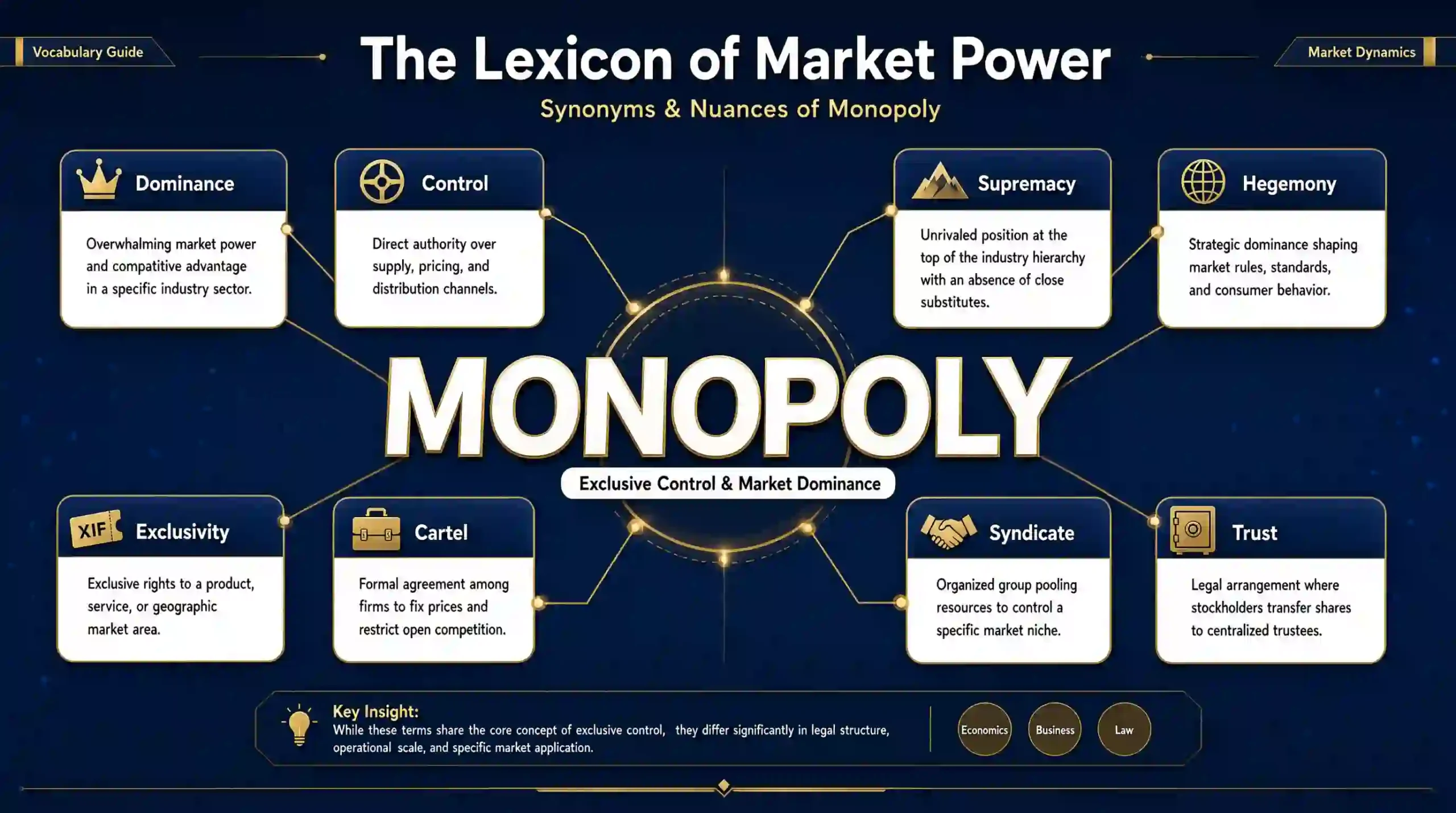
Monopoly means one person or company has full control over a market. It often limits competition and gives buyers fewer choices.
Learning synonyms for monopoly helps you understand business, economics, and everyday English. These words can explain control, power, and market dominance.
Students can use these synonyms in essays and school projects. Bloggers and content writers can also use them to make their articles clearer.
In this guide, you will discover useful synonyms for monopoly with simple meanings. These words will help you improve your vocabulary and express your ideas with confidence.
1. Control
Meaning: Control means having the power to manage or direct something.
Examples:
- One company has control over the local water supply.
- She wants more control over her own business.
2. Dominance
Meaning: Dominance means having more power or influence than others.
Examples:
- The brand has dominance in the phone market.
- Their team’s dominance lasted for many years.
3. Exclusivity
Meaning: Exclusivity means allowing only one person or group to have or use something.
Examples:
- The shop has exclusivity for selling this brand.
- The deal gives the company exclusivity in the area.
4. Sole Ownership
Meaning: Sole ownership means that one person or group owns something alone.
Examples:
- She has sole ownership of the small store.
- Sole ownership gives him full control of the property.
5. Supremacy
Meaning: Supremacy means having the highest level of power or authority.
Examples:
- The firm fought to keep its supremacy in the market.
- The team worked hard to gain supremacy in the league.
6. Command
Meaning: Command means having the power to direct or control something.
Examples:
- The company has a strong command of the local market.
- He has command over the daily work at the factory.
7. Authority
Meaning: Authority means the power to make choices or give orders.
Examples:
- The board has authority over the business.
- The law gives the agency authority to check prices.
8. Power
Meaning: Power means the ability to control people, things, or events.
Examples:
- The firm has great power in the energy sector.
- Money can give a business more power in the market.
9. Leadership
Meaning: Leadership means being ahead of others or guiding them.
Examples:
- The brand has market leadership in its field.
- Strong leadership helped the company grow.
10. Preeminence
Meaning: Preeminence means being more important or successful than others.
Examples:
- The firm gained preeminence in computer software.
- Her shop earned preeminence through great customer service.
11. Hegemony
Meaning: Hegemony means the strong influence or control of one group over others.
Examples:
- The company sought hegemony in the regional market.
- The book explains the country’s hegemony over trade.
12. Supremacy of the Market
Meaning: Supremacy of the market means having the strongest position in a market.
Examples:
- The brand aimed for supremacy of the market.
- New rivals challenged its supremacy in the market.
13. Market Control
Meaning: Market control means having strong power over how a market works.
Examples:
- The firm gained market control after several rivals closed.
- Regulators studied the company’s market control.
14. Market Dominance
Meaning: Market dominance means having a stronger position than competitors in a market.
Examples:
- Its low prices helped it build market dominance.
- The report looked at market dominance in online shopping.
15. Exclusive Control
Meaning: Exclusive control means having power over something without sharing it with others.
Examples:
- The firm gained exclusive control of the new service.
- Exclusive control over the supply raised concerns.
16. Single-Seller Market
Meaning: A single-seller market is a market where only one seller offers a product or service.
Examples:
- The town had a single-seller market for basic phone service.
- A single-seller market may give buyers fewer choices.
17. Market Power
Meaning: Market power is the ability of a business to influence prices or sales.
Examples:
- The company used its market power to set higher prices.
- New laws can limit unfair market power.
18. Concentration of Power
Meaning: Concentration of power means that much of the control rests with one person or group.
Examples:
- The deal led to a concentration of power in one firm.
- The law aims to prevent a harmful concentration of power.
19. Centralization
Meaning: Centralization means placing control in one main place or group.
Examples:
- Centralization gave the head office more control over sales.
- The company chose centralization to make decisions faster.
20. Consolidation
Meaning: Consolidation means joining things together to make one stronger whole.
Examples:
- The merger led to the consolidation of two large firms.
- Market consolidation left fewer choices for buyers.
21. Takeover
Meaning: A takeover happens when one person or company gains control of another business.
Examples:
- The takeover gave the buyer control of the rival firm.
- Workers worried about job cuts after the takeover.
22. Monopoly Power
Meaning: Monopoly power is the ability of one seller to influence a market without strong competition.
Examples:
- The regulator checked whether the firm had monopoly power.
- Monopoly power can make it hard for new firms to compete.
23. Market Supremacy
Meaning: Market supremacy means being the most powerful business in a market.
Examples:
- The company spent years trying to achieve market supremacy.
- Its new product helped strengthen its market supremacy.
24. Exclusive Rights
Meaning: Exclusive rights give one person or group the only legal right to do something.
Examples:
- The author gave the publisher exclusive rights to the book.
- The company received exclusive rights to sell the product.
25. Monopoly Control
Meaning: Monopoly control means having nearly all the power in a market with little competition.
Examples:
- The report raised concerns about monopoly control of the service.
- Officials reviewed the firm’s monopoly control over supply.
26. Domination
Meaning: Domination means having more control or influence than others.
Examples:
- The firm’s domination made it hard for rivals to grow.
- The team ended its rival’s domination of the sport.
27. Lock on the Market
Meaning: A lock on the market means having a very strong hold over sales or customers.
Examples:
- The popular brand seemed to have a lock on the market.
- New stores tried to break the old firm’s lock on the market.
28. Stranglehold
Meaning: A stranglehold is such strong control that others find it hard to compete or act freely.
Examples:
- The company had a stranglehold on local transport.
- Small shops struggled against the supplier’s stranglehold.
29. Cartel
Meaning: A cartel is a group of businesses that work together to limit competition or control prices.
Examples:
- The investigation focused on a cartel that fixed prices.
- Laws can punish firms that form an illegal cartel.
30. Oligopoly
Meaning: An oligopoly is a market controlled by a small number of large sellers.
Examples:
- The airline industry in that region was an oligopoly.
- In an oligopoly, a few firms may have strong market power.
Conclusion
Learning synonyms for monopoly helps improve your writing, blogging, speaking, and daily communication. Words such as control, dominance, market power, and exclusivity help you explain business ideas more clearly. Practice these words in emails, essays, and everyday conversations. Remember that not every synonym has exactly the same meaning, so choose the word that best fits your sentence. With regular practice, you can build a stronger vocabulary and express your ideas with confidence.