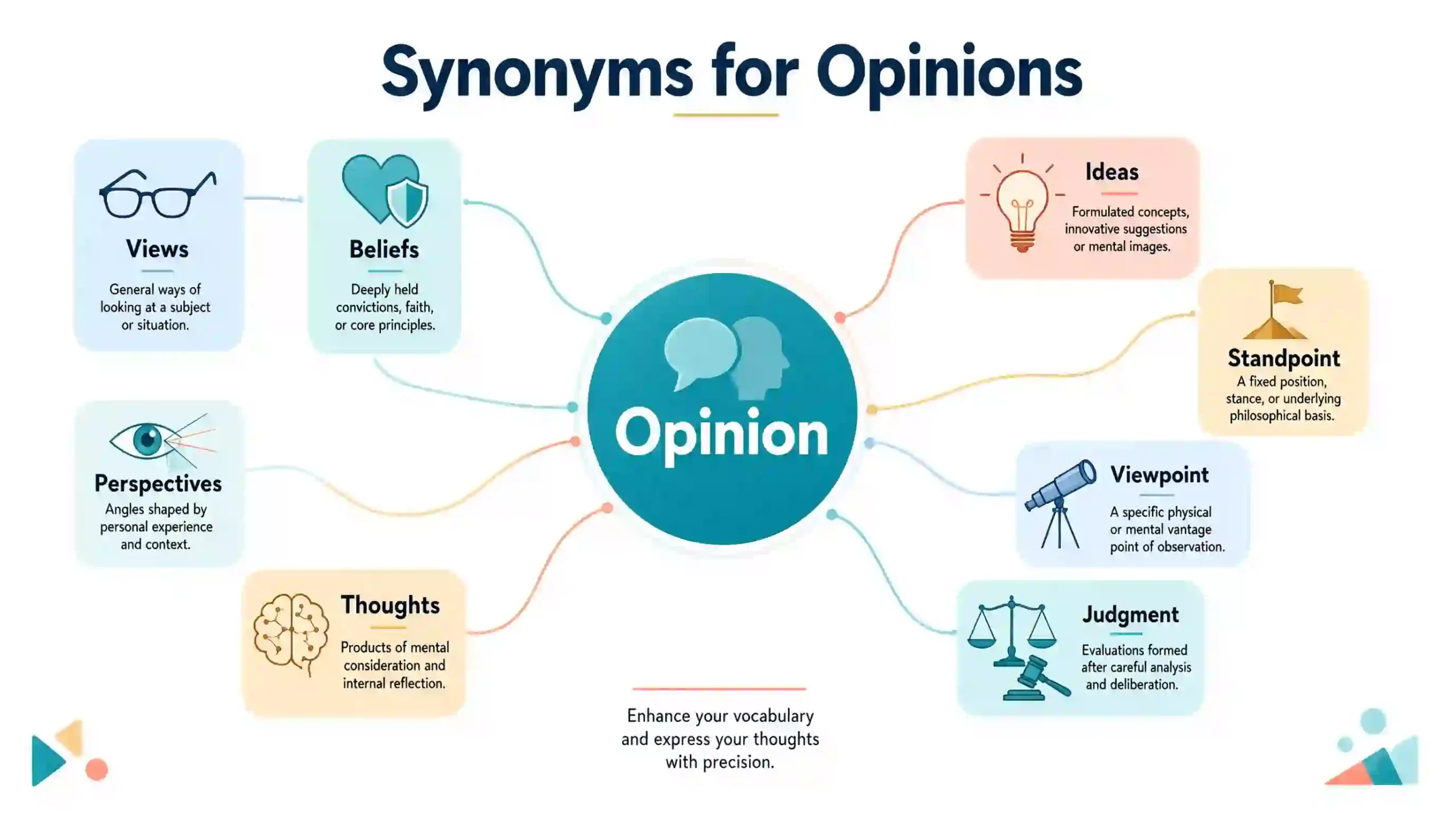
Opinions are personal thoughts or beliefs about a topic, person, or situation. Everyone has different opinions based on their experiences and ideas.
Learning synonyms for opinions helps you express your thoughts in many ways. Words like views, beliefs, ideas, and perspectives have similar meanings.
These words are useful for students who write essays and answer questions. Bloggers and content writers can also use them to make their writing more interesting.
In this guide, you will discover useful synonyms for opinions with simple meanings and examples. Practice these words to improve your vocabulary and share your thoughts clearly.
30 Synonyms for Opinions
1. Views
Meaning: Views are the thoughts or ideas a person has about something.
Examples:
- Her views on education are interesting.
- We shared our views during the meeting.
2. Thoughts
Meaning: Thoughts are ideas or feelings that come to your mind.
Examples:
- I would love to hear your thoughts on this book.
- His thoughts helped us understand the problem.
3. Beliefs
Meaning: Beliefs are ideas that someone feels are true.
Examples:
- Her beliefs guide the choices she makes.
- We should respect other people’s beliefs.
4. Ideas
Meaning: Ideas are thoughts that you have about a person, thing, or topic.
Examples:
- The teacher asked us to share our ideas.
- I have a few ideas for the school project.
5. Perspectives
Meaning: Perspectives are the different ways people see or understand something.
Examples:
- Try to understand the issue from her perspective.
- The book offers new perspectives on family life.
6. Positions
Meaning: Positions are the sides or opinions people take on an issue.
Examples:
- The group explained its position on the new rule.
- I understand your position, even if I disagree.
7. Stances
Meaning: Stances are clear opinions that people hold about a topic.
Examples:
- The writer took a strong stance on climate change.
- Her stance on school uniforms has not changed.
8. Judgments
Meaning: Judgments are opinions formed after thinking about something.
Examples:
- Do not make quick judgments about others.
- His judgment of the plan was fair.
9. Impressions
Meaning: Impressions are feelings or ideas you get about someone or something.
Examples:
- My first impression of the new teacher was good.
- The visit left a strong impression on me.
10. Viewpoints
Meaning: Viewpoints are the ways people think about or understand an issue.
Examples:
- The article explains different viewpoints.
- I respect your viewpoint on this matter.
11. Convictions
Meaning: Convictions are strong beliefs that a person feels sure about.
Examples:
- She stood by her convictions.
- His convictions helped him make a firm choice.
12. Attitudes
Meaning: Attitudes are the ways people think or feel about something.
Examples:
- A positive attitude can make hard work easier.
- His attitude toward learning has improved.
13. Preferences
Meaning: Preferences are the things someone likes or chooses more than others.
Examples:
- Everyone has different food preferences.
- Her preference is to study in the morning.
14. Feelings
Meaning: Feelings are the emotions or personal thoughts you have about something.
Examples:
- Tell me your feelings about the new plan.
- His feelings about the change were easy to understand.
15. Reflections
Meaning: Reflections are thoughts you have after thinking carefully about something.
Examples:
- She shared her reflections after the trip.
- His reflections on the lesson were helpful.
16. Assessments
Meaning: Assessments are opinions made after looking at or studying something.
Examples:
- The coach gave an assessment of the team’s work.
- Her assessment of the project was clear.
17. Evaluations
Meaning: Evaluations are careful opinions about the value or quality of something.
Examples:
- We received an evaluation of our school project.
- The manager shared her evaluation of the new plan.
18. Remarks
Meaning: Remarks are things people say or write about a topic.
Examples:
- His remarks about the event were kind.
- The teacher made a few remarks about my essay.
19. Comments
Meaning: Comments are spoken or written thoughts about something.
Examples:
- I read the comments below the article.
- She made a helpful comment during the discussion.
20. Reactions
Meaning: Reactions are the feelings or responses people show about something.
Examples:
- The news caused different reactions.
- His reaction to the gift was full of joy.
21. Interpretations
Meaning: Interpretations are the ways people explain or understand something.
Examples:
- The poem has many possible interpretations.
- Her interpretation of the story was very clear.
22. Conclusions
Meaning: Conclusions are ideas or decisions reached after thinking about facts.
Examples:
- We reached the same conclusion after the talk.
- His conclusion was based on the available facts.
23. Theories
Meaning: Theories are ideas that explain why or how something may happen.
Examples:
- The students shared their theories about the mystery.
- Her theory about the story was interesting.
24. Assumptions
Meaning: Assumptions are ideas that people accept as true without checking them first.
Examples:
- Do not make assumptions about someone you just met.
- His assumption about the test was wrong.
25. Suggestions
Meaning: Suggestions are ideas offered to help someone make a choice or solve a problem.
Examples:
- Thank you for your suggestions about my essay.
- The team gave a useful suggestion for the event.
26. Recommendations
Meaning: Recommendations are ideas about what someone should choose or do.
Examples:
- I trust her recommendations for good books.
- The guide gave recommendations for family trips.
27. Critiques
Meaning: Critiques are opinions that explain what is good or bad about something.
Examples:
- The teacher wrote a critique of the short story.
- His critique helped the artist improve the painting.
28. Appraisals
Meaning: Appraisals are opinions about the value, quality, or worth of something.
Examples:
- The house received a fair appraisal.
- Her appraisal of the team’s work was positive.
29. Beliefs and Views
Meaning: Beliefs and views are the ideas people hold about life, people, or events.
Examples:
- Their beliefs and views shaped the discussion.
- We talked about our beliefs and views at dinner.
30. Convictions and Ideas
Meaning: Convictions and ideas are strong thoughts that guide what someone thinks or does.
Examples:
- Her convictions and ideas inspired the group.
- The speaker shared convictions and ideas about education.
Conclusion
Learning synonyms for opinions helps you express your thoughts in fresh and clear ways. Words like views, beliefs, perspectives, and stances can improve your writing, blogging, speaking, and communication. Each word has a slightly different use, so choose the one that fits your meaning. Practice these words in emails, essays, and daily conversations to build stronger English skills.