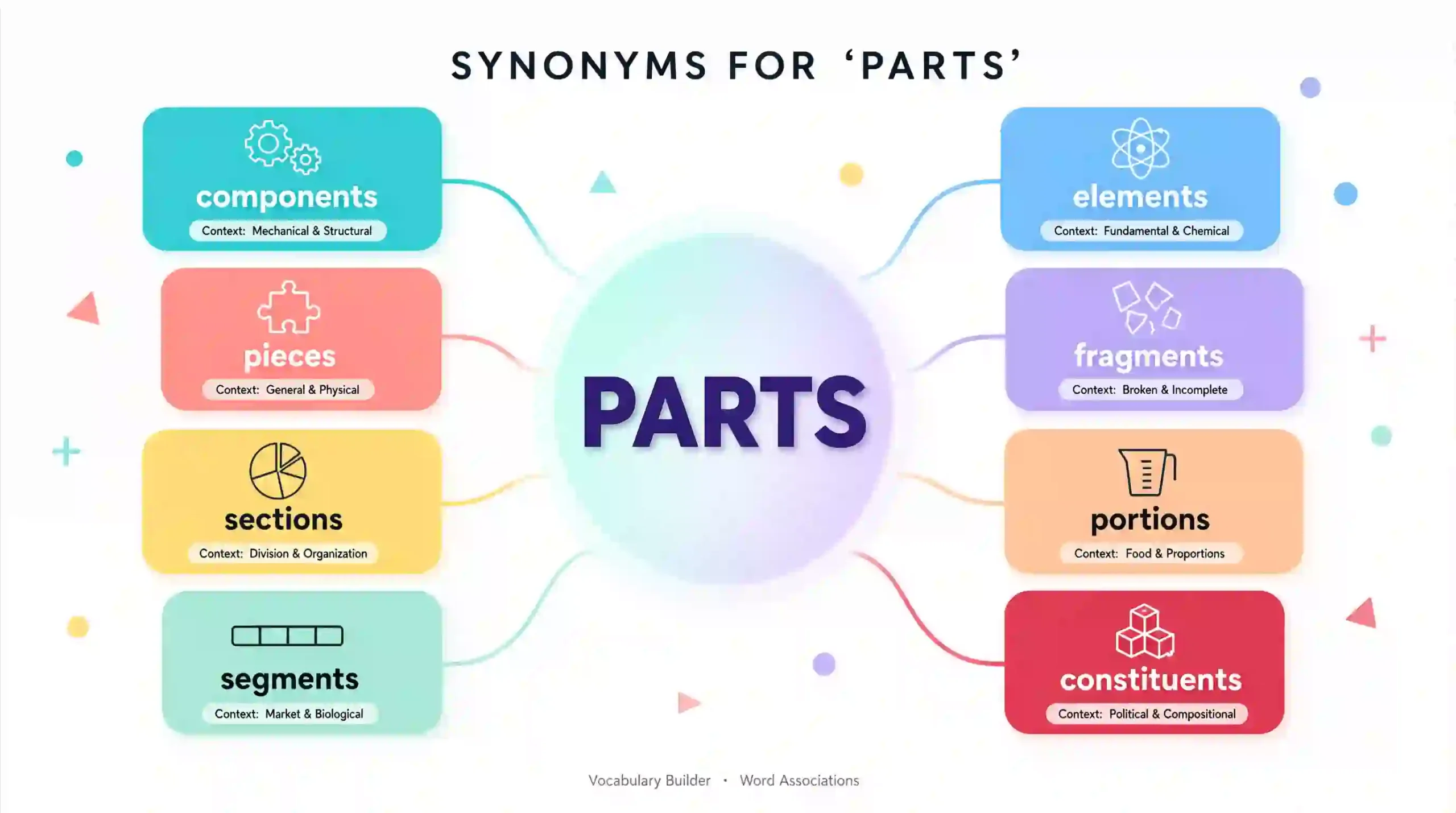
The word “parts” refers to pieces or sections of something. We use it in daily life when talking about objects, machines, stories, or tasks.
Learning synonyms for parts can help you find better words for different situations. Words like pieces, sections, elements, and portions have similar meanings.
Students can use these words in essays and homework. Bloggers and writers can also use them to make their content clear and interesting.
In this guide, you will discover useful synonyms for parts with simple meanings and examples. These words will help improve your vocabulary and make your English more natural.
1. Pieces
Meaning: Pieces are separate bits of something that may form a whole.
Examples:
- The toy broke into small pieces.
- She put the puzzle pieces together.
2. Sections
Meaning: Sections are separate areas or divisions of a larger thing.
Examples:
- This book has five main sections.
- Please read the first section of the report.
3. Components
Meaning: Components are the items that make up something larger.
Examples:
- The computer has many useful components.
- Each component must work well.
4. Elements
Meaning: Elements are basic things that help make up a whole.
Examples:
- Trust is an important element of friendship.
- The design has several simple elements.
5. Portions
Meaning: Portions are separate amounts or shares of something.
Examples:
- He ate a small portion of the cake.
- We divided the work into equal portions.
6. Segments
Meaning: Segments are separate parts of a whole.
Examples:
- The orange has several juicy segments.
- The show has three short segments.
7. Pieces and Pieces
Meaning: This phrase describes separate bits of something, but “pieces” alone is usually clearer.
Examples:
- The old plate fell into pieces.
- He collected the pieces from the floor.
8. Divisions
Meaning: Divisions are sections made by separating something into smaller groups.
Examples:
- The school has three main divisions.
- We split the class into two divisions.
9. Portions of a Whole
Meaning: These are separate shares that together make up one complete thing.
Examples:
- Each child received a portion of the prize.
- The project has different portions to complete.
10. Sections of a Whole
Meaning: These are smaller areas or groups within something larger.
Examples:
- The map shows different sections of the city.
- Each section of the garden has flowers.
11. Units
Meaning: Units are separate items or parts that can work as one group.
Examples:
- The course has ten learning units.
- Each unit covers a new topic.
12. Modules
Meaning: Modules are separate sections of a course, system, or program.
Examples:
- I finished the first module today.
- The training has six short modules.
13. Features
Meaning: Features are important parts or qualities of something.
Examples:
- The phone has many useful features.
- The best feature is its clear screen.
14. Aspects
Meaning: Aspects are different sides or points of a subject.
Examples:
- We discussed every aspect of the plan.
- Cost is one aspect of the problem.
15. Areas
Meaning: Areas are specific places or sections of something.
Examples:
- Keep this area clean.
- The report covers several areas of study.
16. Divisions of Work
Meaning: These are separate tasks or sections of a larger job.
Examples:
- The team shared the divisions of work.
- Each person completed one division of work.
17. Ingredients
Meaning: Ingredients are items used to make food or another mixture.
Examples:
- Flour and eggs are key ingredients.
- We need fresh ingredients for dinner.
18. Materials
Meaning: Materials are the things used to make or build something.
Examples:
- The artist gathered her materials.
- Wood is one of the main materials in this chair.
19. Sections of a Body
Meaning: These are the different areas or structures that make up a body.
Examples:
- The doctor explained the sections of the body.
- We learned about the main body sections in class.
20. Members
Meaning: Members are people or items that belong to a group.
Examples:
- All members of the team joined the meeting.
- The club welcomed three new members.
21. Branches
Meaning: Branches are smaller parts that grow or spread from a main thing.
Examples:
- The company has branches in many cities.
- Science has several different branches.
22. Subsections
Meaning: Subsections are smaller sections within a larger section.
Examples:
- Add a title to each subsection.
- The report includes a subsection about safety.
23. Fragments
Meaning: Fragments are small pieces broken off from something larger.
Examples:
- A fragment of glass was on the floor.
- She found a fragment of the old letter.
24. Components of a System
Meaning: These are the items that work together in one system.
Examples:
- The technician checked all components of the system.
- Each component of the system has a clear role.
25. Details
Meaning: Details are small facts or features that help explain something.
Examples:
- Please check the details before signing.
- The story includes many interesting details.
26. Factors
Meaning: Factors are things that help cause or affect a result.
Examples:
- Time is an important factor in this plan.
- Many factors can affect the final result.
27. Pieces of Equipment
Meaning: These are separate items used for a task or activity.
Examples:
- The gym has several pieces of equipment.
- Please clean each piece of equipment after use.
28. Passages
Meaning: Passages are sections of written or spoken text.
Examples:
- Read the passage before answering.
- The teacher explained a difficult passage.
29. Chapters
Meaning: Chapters are main sections of a book or story.
Examples:
- I read two chapters last night.
- The final chapter has a happy ending.
30. Stages
Meaning: Stages are steps or periods in a process.
Examples:
- The project has four main stages.
- Each stage needs careful planning.
Conclusion
Learning synonyms for parts can make your writing, blogging, speaking, and communication better. Words like pieces, sections, components, and elements help you explain ideas in a clear way. Remember that some words fit certain situations better than others. Practice using these words in emails, essays, and daily conversations. With regular practice, you can build a stronger vocabulary and express your thoughts with ease.