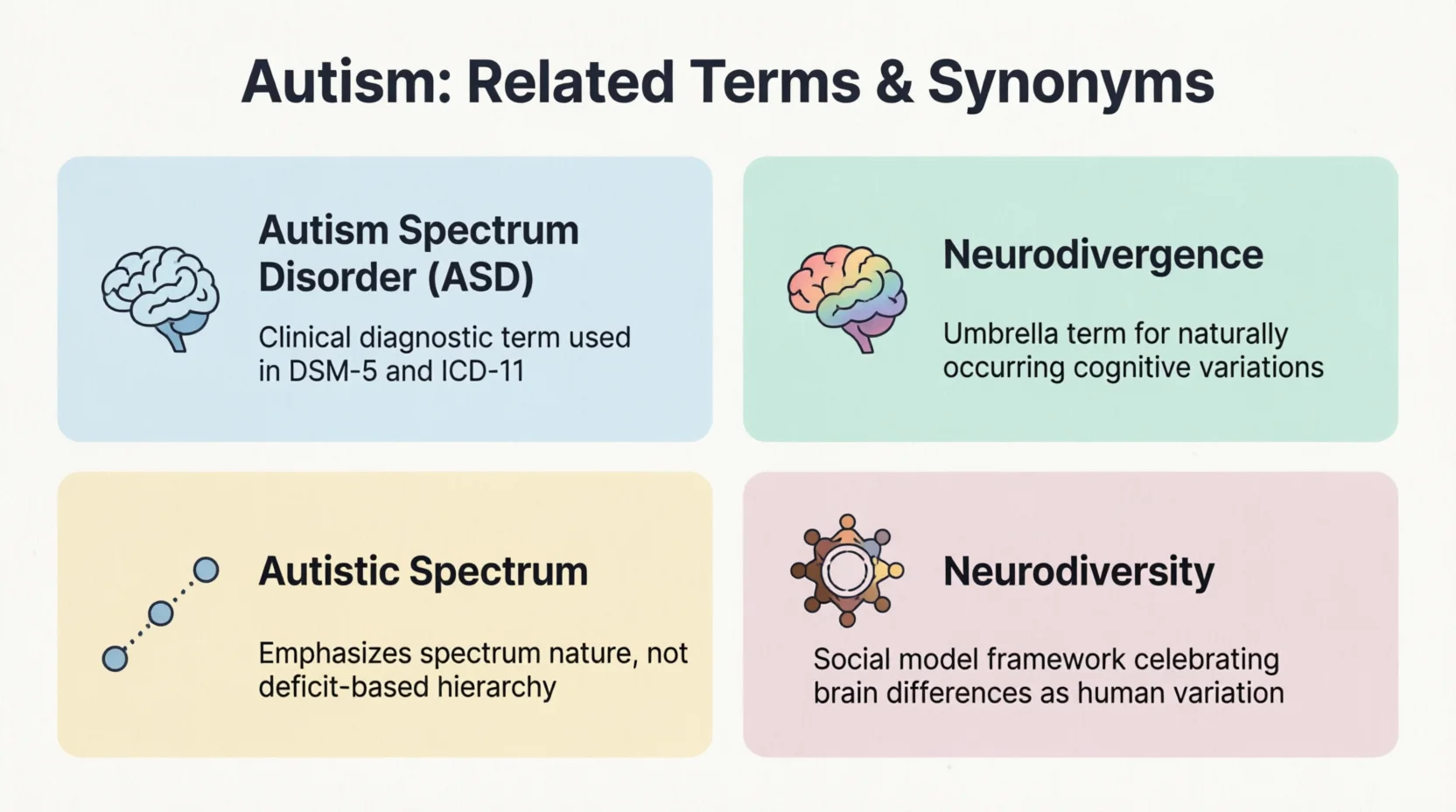
Finding suitable synonyms for autism can help writers communicate ideas clearly and respectfully. Different terms may be used in medical, educational, or everyday conversations.
Common related expressions include autism spectrum disorder, autism spectrum condition, and neurodevelopmental condition. Each term can have a slightly different context or purpose.
Understanding these expressions helps students, teachers, writers, and learners choose appropriate language when discussing autism and related topics.
In this guide, we explore useful synonyms and related terms, along with their meanings, contexts, and simple examples for easier understanding.
1. Autism Spectrum Disorder
Meaning: Autism spectrum disorder is the clinical term commonly used for autism.
Examples:
- The doctor explained autism spectrum disorder to the family.
- The article discusses autism spectrum disorder in simple language.
2. Autism Spectrum
Meaning: Autism spectrum describes the wide range of ways autism can affect different people.
Examples:
- People on the autism spectrum can have different strengths.
- The teacher learned more about the autism spectrum.
3. Autistic
Meaning: Autistic is an adjective used to describe a person who has autism.
Examples:
- Her brother is autistic.
- The school provides support for autistic students.
4. Autistic Person
Meaning: Autistic person means a person who has autism.
Examples:
- The speaker shared her experience as an autistic person.
- An autistic person may have unique ways of learning.
5. Neurodevelopmental Condition
Meaning: A neurodevelopmental condition affects how the brain develops and works.
Examples:
- Autism is a neurodevelopmental condition.
- The lesson explained several neurodevelopmental conditions.
6. Neurodevelopmental Difference
Meaning: A neurodevelopmental difference describes a difference in how a person’s brain develops or processes information.
Examples:
- Autism can be described as a neurodevelopmental difference.
- The teacher discussed neurodevelopmental differences respectfully.
7. Neurodivergence
Meaning: Neurodivergence describes brain development or thinking that differs from what is considered typical.
Examples:
- The workshop included a discussion about neurodivergence.
- Neurodivergence can involve different ways of thinking and learning.
8. Neurodivergent
Meaning: Neurodivergent describes a person whose brain works in ways that differ from typical patterns.
Examples:
- He describes himself as neurodivergent.
- The group included several neurodivergent students.
9. Autism Condition
Meaning: Autism condition is a general phrase used to refer to autism.
Examples:
- The guide explains the autism condition clearly.
- Families may seek information about the autism condition.
10. Autistic Spectrum Condition
Meaning: Autistic spectrum condition is a phrase sometimes used to describe autism.
Examples:
- The book discusses autistic spectrum condition.
- The teacher attended training about autistic spectrum condition.
11. Social Communication Difference
Meaning: A social communication difference describes differences in how a person communicates and interacts with others.
Examples:
- Autism may involve social communication differences.
- The lesson explained social communication differences.
12. Communication Difference
Meaning: A communication difference means a person may communicate in ways that differ from others.
Examples:
- The student has a communication difference.
- Communication differences can affect classroom activities.
13. Social Interaction Difference
Meaning: A social interaction difference means a person may experience social situations differently.
Examples:
- Autism can involve social interaction differences.
- The teacher learned about social interaction differences.
14. Sensory Difference
Meaning: A sensory difference means a person may experience sounds, lights, touch, or other senses differently.
Examples:
- Loud music can be difficult for someone with sensory differences.
- The classroom was changed to support sensory differences.
15. Sensory Processing Difference
Meaning: A sensory processing difference means the brain may handle sensory information differently.
Examples:
- The child has sensory processing differences.
- Quiet spaces can help with sensory processing differences.
16. Repetitive Behavior
Meaning: Repetitive behavior means doing the same action or activity again and again.
Examples:
- Repetitive behavior can be one feature of autism.
- The teacher noticed repetitive behavior during the activity.
17. Repetitive Movement
Meaning: Repetitive movement means making the same body movement repeatedly.
Examples:
- Repetitive movement can help some autistic people feel calm.
- The child showed repetitive movement while waiting.
18. Restricted Interests
Meaning: Restricted interests are strong interests that may focus closely on particular subjects.
Examples:
- He has a strong interest in trains.
- Restricted interests can bring joy and comfort.
19. Focused Interests
Meaning: Focused interests are subjects or activities that a person knows or enjoys deeply.
Examples:
- Her focused interests include astronomy and history.
- Focused interests can support learning.
20. Special Interests
Meaning: Special interests is a commonly used phrase for subjects that an autistic person may enjoy or study deeply.
Examples:
- His special interests include maps and animals.
- She loves sharing facts about her special interests.
21. Need for Routine
Meaning: Need for routine means feeling more comfortable when daily activities follow a familiar pattern.
Examples:
- A need for routine can be important for some autistic people.
- His need for routine helps him plan his school day.
22. Preference for Routine
Meaning: Preference for routine means liking familiar plans and predictable activities.
Examples:
- She has a strong preference for routine.
- A preference for routine helps him feel prepared.
23. Repetitive Patterns
Meaning: Repetitive patterns are repeated actions, behaviors, or activities.
Examples:
- The teacher noticed repetitive patterns in the student’s play.
- Repetitive patterns may appear in some autistic behaviors.
24. Social Communication Condition
Meaning: Social communication condition is a broad phrase related to differences in communication and social interaction.
Examples:
- The course covered social communication conditions.
- The teacher studied social communication conditions.
25. Developmental Difference
Meaning: A developmental difference means that development may happen in a different way or at a different pace.
Examples:
- The doctor discussed the child’s developmental differences.
- Every child can have a different developmental path.
26. Developmental Disability
Meaning: A developmental disability is a condition that begins during development and can affect everyday life.
Examples:
- Autism is recognized as a developmental disability in many contexts.
- The program provides support for people with developmental disabilities.
27. Autism-Related Traits
Meaning: Autism-related traits are characteristics that can occur in autistic people.
Examples:
- The assessment looked at several autism-related traits.
- Autism-related traits can vary from person to person.
28. Autistic Traits
Meaning: Autistic traits are characteristics associated with autism.
Examples:
- The researcher studied autistic traits in children.
- Autistic traits can appear differently in different people.
29. Autism Characteristics
Meaning: Autism characteristics are features that may be associated with autism.
Examples:
- The guide explains common autism characteristics.
- Autism characteristics can differ widely between individuals.
30. Autism Profile
Meaning: An autism profile describes the particular strengths, needs, and characteristics of an autistic person.
Examples:
- Every autistic person can have a different autism profile.
- The specialist discussed the student’s autism profile with the family.
Conclusion
Learning related terms for autism can improve writing, blogging, speaking, and everyday communication. Words such as autistic, neurodivergent, sensory difference, focused interests, and autism spectrum can describe different parts of the topic. Remember that these terms are not all exact synonyms. Use the term that best matches the meaning you want to express. Practice respectful vocabulary in emails, essays, articles, and daily conversations to communicate clearly and thoughtfully.