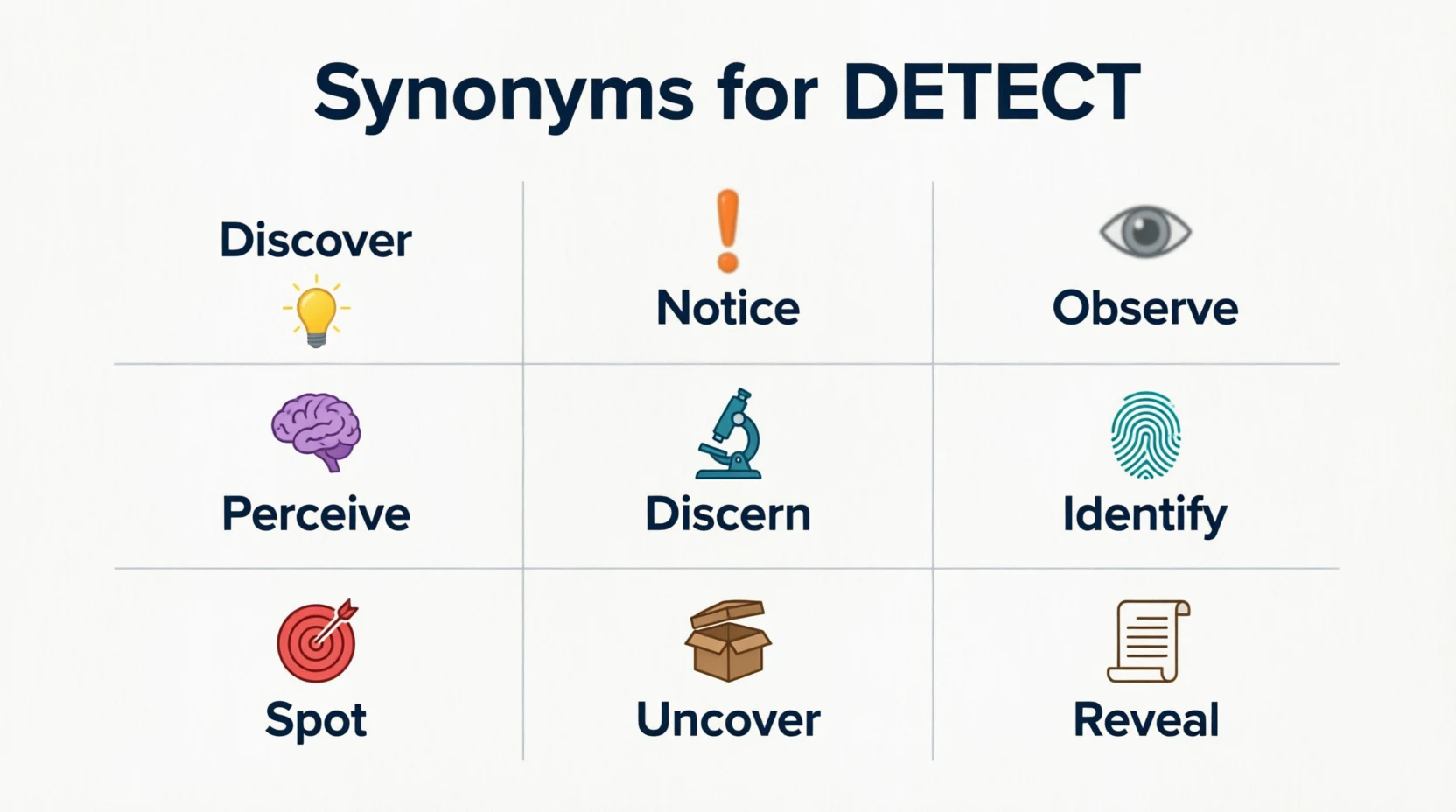
Finding the right synonyms for detect can make your English clearer, smoother, and more natural in different situations.
Words like notice, discover, identify, spot, observe, and recognize can replace detect depending on the context.
These alternatives help students, writers, bloggers, and English learners avoid repetition while improving vocabulary and sentence variety.
In this guide, you will learn useful synonyms for detect with simple meanings and clear examples.
1. Notice
Meaning: To notice means to see or become aware of something.
Examples:
- I noticed a small crack in the window.
- She noticed that the room was quiet.
2. Discover
Meaning: To discover means to find something that was not known before.
Examples:
- We discovered a hidden path near the park.
- The student discovered an error in his answer.
3. Find
Meaning: To find means to discover or locate something.
Examples:
- I found a useful book on the shelf.
- They found the missing key under the chair.
4. Spot
Meaning: To spot means to see or notice something quickly.
Examples:
- Can you spot the bird in the tree?
- Mia spotted her friend across the street.
5. Identify
Meaning: To identify means to recognize or name something correctly.
Examples:
- The doctor identified the cause of the problem.
- Can you identify this plant?
6. Recognize
Meaning: To recognize means to know someone or something because you have seen it before.
Examples:
- I recognized his voice on the phone.
- She recognized the old house immediately.
7. Observe
Meaning: To observe means to watch something carefully.
Examples:
- We observed the birds from the window.
- The teacher observed the students during the activity.
8. Uncover
Meaning: To uncover means to find something hidden or unknown.
Examples:
- The team uncovered an old box in the garden.
- Reporters uncovered new facts about the story.
9. Reveal
Meaning: To reveal means to show something that was hidden or unknown.
Examples:
- The test revealed a small problem.
- The report revealed several useful facts.
10. Expose
Meaning: To expose means to make something hidden or secret known.
Examples:
- The investigation exposed the mistake.
- The bright light exposed dust on the table.
11. Discern
Meaning: To discern means to notice or understand something that may be hard to see.
Examples:
- I could barely discern a shape in the fog.
- She discerned a change in his voice.
12. Perceive
Meaning: To perceive means to notice or become aware of something.
Examples:
- He perceived a change in the weather.
- The child perceived fear in the dog’s behavior.
13. Recognize
Meaning: To recognize means to notice and know something from its familiar features.
Examples:
- She recognized the song after a few seconds.
- I recognized the logo on the package.
14. Ascertain
Meaning: To ascertain means to find out something with care.
Examples:
- The officer tried to ascertain the cause.
- We need to ascertain the correct date.
15. Determine
Meaning: To determine means to find out something after checking the facts.
Examples:
- The test helped determine the source of the issue.
- We must determine the best time for the meeting.
16. Establish
Meaning: To establish means to find or confirm something as true or certain.
Examples:
- The research established a clear connection.
- The team established what caused the delay.
17. Verify
Meaning: To verify means to check that something is true or correct.
Examples:
- Please verify your email address.
- The editor verified the information before publishing it.
18. Check
Meaning: To check means to look at something carefully to find a problem.
Examples:
- I checked the car before the trip.
- Please check your homework for mistakes.
19. Examine
Meaning: To examine means to look at something closely to understand it.
Examples:
- The scientist examined the sample.
- She examined the painting for damage.
20. Inspect
Meaning: To inspect means to look over something carefully.
Examples:
- The worker inspected the machine.
- Dad inspected the bike before buying it.
21. Investigate
Meaning: To investigate means to carefully search for facts about something.
Examples:
- The police investigated the unusual event.
- The manager investigated the reason for the delay.
22. Explore
Meaning: To explore means to look around or study something to learn more about it.
Examples:
- We explored the old building.
- The class explored different ways to solve the problem.
23. Search
Meaning: To search means to look carefully for someone or something.
Examples:
- I searched my bag for my notebook.
- They searched the room for the missing toy.
24. Locate
Meaning: To locate means to find the exact place where something is.
Examples:
- We located the store using a map.
- The app helped me locate my phone.
25. Trace
Meaning: To trace means to find where something came from or where it went.
Examples:
- The team traced the message to its source.
- We traced the leak to a broken pipe.
26. Monitor
Meaning: To monitor means to watch something over time for changes or problems.
Examples:
- The nurse monitored the patient’s temperature.
- We monitored the weather during the trip.
27. Test
Meaning: To test means to check something to learn if it works or is correct.
Examples:
- The technician tested the new device.
- We tested the water before using it.
28. Diagnose
Meaning: To diagnose means to identify a problem or illness by checking its signs.
Examples:
- The doctor diagnosed the problem quickly.
- The mechanic diagnosed the car’s engine issue.
29. Pinpoint
Meaning: To pinpoint means to find the exact cause, place, or detail of something.
Examples:
- The team pinpointed the source of the noise.
- We finally pinpointed the cause of the error.
30. Catch
Meaning: To catch can mean to notice or find something that is easy to miss.
Examples:
- I caught a mistake in the final paragraph.
- She caught a strange detail in the photo.
Conclusion
Learning synonyms for detect gives you more ways to express ideas clearly. Words like notice, discover, spot, identify, verify, and examine can make your writing more useful and natural. Students can use them in essays, while bloggers and content writers can avoid repeating the same word. Daily English users can also practice these words in emails and conversations. Start with a few words and use them often.