Exposition means explaining or presenting an idea clearly. It is often used when someone gives information, describes something, or helps others understand a topic better.
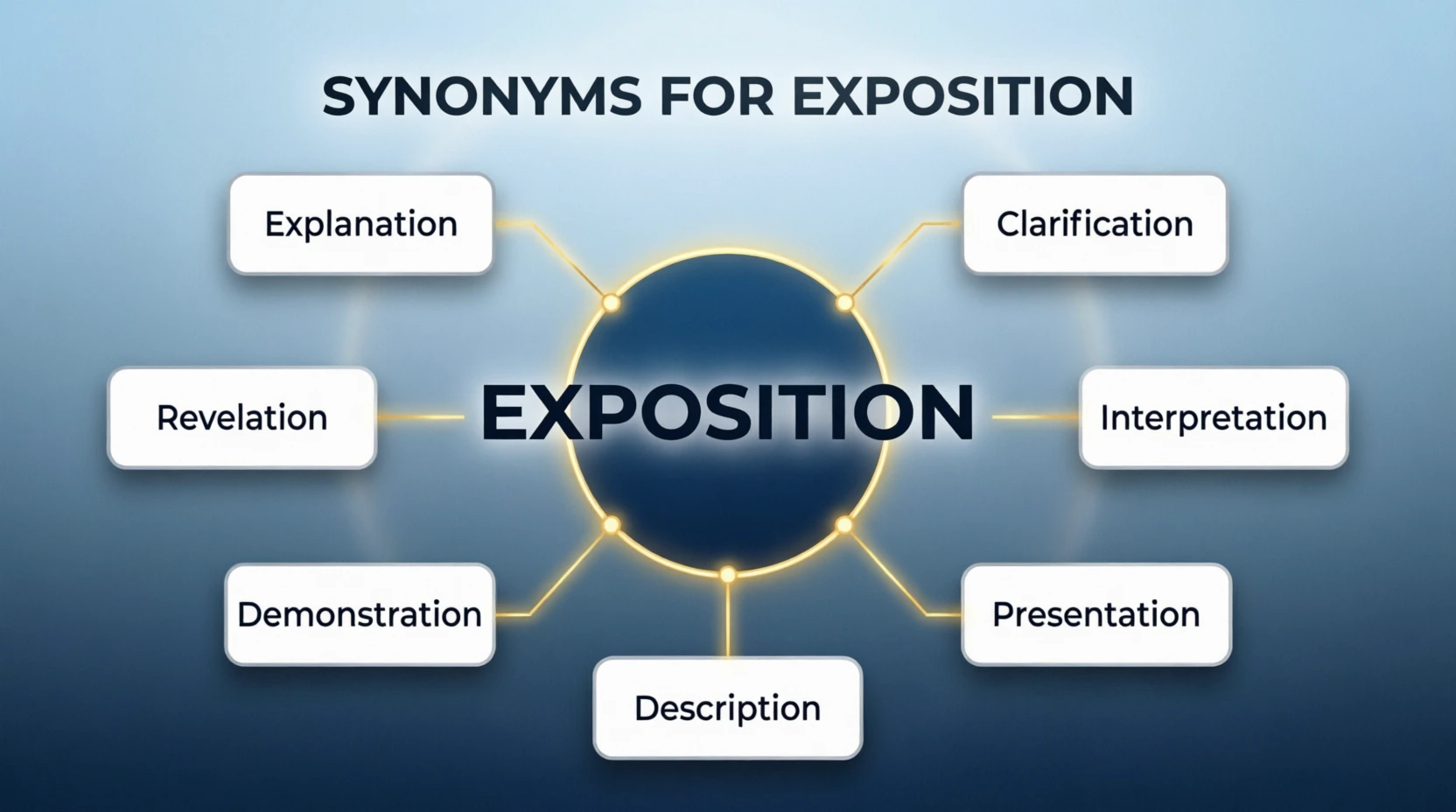
If you are looking for synonyms for exposition, words like explanation, description, presentation, clarification, and disclosure can be useful.
Each synonym has a slightly different meaning and fits different situations. Knowing these alternatives can make your writing more natural, clear, and interesting.
In this guide, you will find simple synonyms for exposition with easy meanings and examples. These words can help students, writers, and English learners improve their vocabulary.
Explanation
Meaning: An explanation gives information that helps someone understand something.
Examples:
- The teacher gave a simple explanation.
- Her explanation made the problem clear.
Description
Meaning: A description tells what someone or something is like.
Examples:
- His description of the room was clear.
- I wrote a short description of the book.
Presentation
Meaning: A presentation is a way of showing or explaining information to others.
Examples:
- Maya gave a presentation about space.
- His presentation was easy to follow.
Clarification
Meaning: Clarification makes an idea easier to understand.
Examples:
- I asked for clarification about the rule.
- The manager gave clarification during the meeting.
Account
Meaning: An account is a report that tells what happened or gives information about something.
Examples:
- She gave an account of the event.
- His account helped us understand what happened.
Elaboration
Meaning: Elaboration adds more details to an idea.
Examples:
- The writer gave more elaboration on the topic.
- Can you provide some elaboration?
Interpretation
Meaning: An interpretation explains the meaning of something.
Examples:
- Her interpretation of the story was interesting.
- We discussed his interpretation of the painting.
Explanation of a Topic
Meaning: An explanation of a topic gives clear information about a subject.
Examples:
- The video offers an explanation of the topic.
- I need an explanation of this lesson.
Illustration
Meaning: An illustration is an example or explanation that makes an idea clearer.
Examples:
- The teacher used an illustration to explain the idea.
- This story is a useful illustration of kindness.
Demonstration
Meaning: A demonstration shows how something works or is done.
Examples:
- The chef gave a demonstration of the recipe.
- We watched a demonstration in science class.
Instruction
Meaning: An instruction tells someone how to do something.
Examples:
- The guide gave clear instructions.
- Follow each instruction carefully.
Information
Meaning: Information is knowledge or facts about something.
Examples:
- The website provides useful information.
- I found new information about the course.
Overview
Meaning: An overview gives a short and general view of a subject.
Examples:
- The teacher gave us an overview of the lesson.
- Read the overview before starting the chapter.
Summary
Meaning: A summary gives the main points in a shorter form.
Examples:
- Please write a summary of the article.
- The summary helped me review the lesson.
Analysis
Meaning: Analysis looks closely at something to understand it better.
Examples:
- The report includes an analysis of the results.
- Her analysis helped explain the problem.
Discussion
Meaning: A discussion is a talk about a subject or idea.
Examples:
- We had a discussion about climate change.
- The discussion helped everyone share ideas.
Report
Meaning: A report gives organized information about a subject or event.
Examples:
- He wrote a report about the school trip.
- The report explains the main results.
Statement
Meaning: A statement is something said or written to give information.
Examples:
- The company released a statement.
- Her statement explained the situation.
Account of Events
Meaning: An account of events tells what happened in order.
Examples:
- The article gives an account of events.
- His account of events was easy to understand.
Narration
Meaning: Narration tells a story or describes events in words.
Examples:
- The film uses narration to explain the story.
- Her narration made the scene more interesting.
Commentary
Meaning: Commentary gives information or opinions about a subject or event.
Examples:
- The sports match included live commentary.
- His commentary helped explain the decision.
Briefing
Meaning: A briefing is a short talk that gives important information.
Examples:
- The team attended a morning briefing.
- The coach gave us a quick briefing.
Guide
Meaning: A guide gives useful information or directions about something.
Examples:
- I read a guide before visiting the museum.
- This guide explains the basic steps.
Teaching
Meaning: Teaching is the act of giving knowledge or skills to someone.
Examples:
- Good teaching makes hard topics easier.
- Her teaching style is simple and friendly.
Instructional Explanation
Meaning: An instructional explanation shows someone how to understand or do something.
Examples:
- The manual gives an instructional explanation.
- His video provides an instructional explanation of the process.
Disclosure
Meaning: A disclosure is information that is made known to others.
Examples:
- The company made a full disclosure.
- The disclosure revealed important facts.
Revelation
Meaning: A revelation is new information that was not known before.
Examples:
- The discovery was a major revelation.
- Her revelation surprised everyone.
Exposition of Ideas
Meaning: An exposition of ideas is a clear presentation of thoughts or concepts.
Examples:
- The essay gives an exposition of ideas.
- His speech offered an exposition of new ideas.
Presentation of Facts
Meaning: A presentation of facts gives clear facts about a subject.
Examples:
- The article provides a presentation of facts.
- Her presentation of facts was very clear.
Explanation of Meaning
Meaning: An explanation of meaning tells what a word, idea, or message means.
Examples:
- The teacher gave an explanation of meaning.
- The dictionary provides an explanation of meaning.
Conclusion
Learning synonyms for exposition can make your English more flexible and clear. Words such as explanation, description, presentation, overview, and clarification fit different situations. Students can use them in essays and school work, while bloggers and content writers can create smoother articles. Daily English users can also use these alternatives in emails, messages, and conversations. Practice choosing the word that best matches your meaning, and your writing and communication will become stronger.