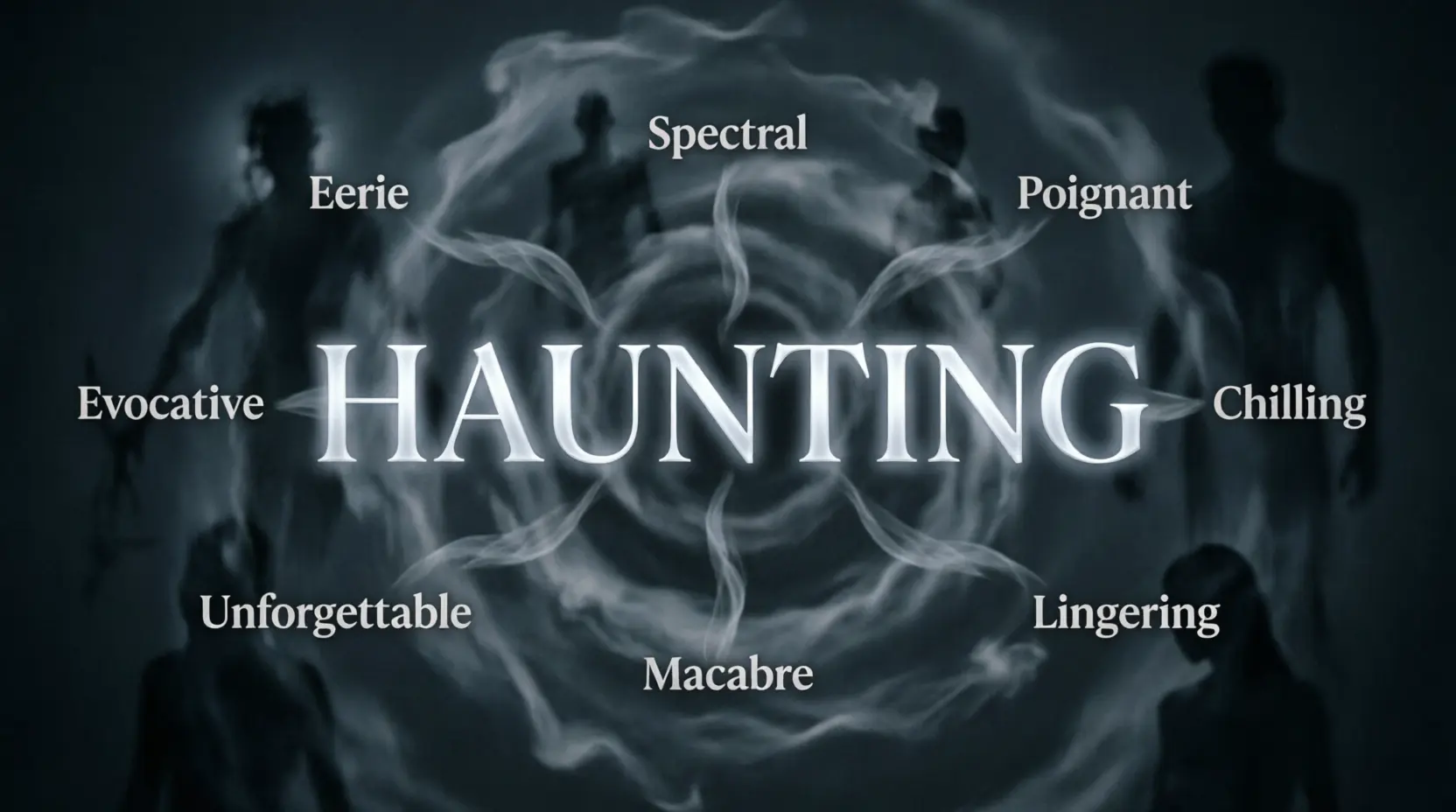
Finding the right synonyms for haunting can make your writing clearer, stronger, and more expressive.
Words like eerie, spooky, ghostly, unsettling, and disturbing can describe different meanings of haunting.
These words are useful when describing scary places, mysterious experiences, or memories that stay in your mind.
In this guide, you will find simple synonyms for haunting with clear meanings and examples for everyday writing.
Eerie
Meaning: Eerie means strange and a little scary.
Examples:
- The empty house had an eerie feeling.
- An eerie sound came from the hallway.
Spooky
Meaning: Spooky means strange or scary in a fun or unsettling way.
Examples:
- We watched a spooky movie last night.
- The old tree looked spooky after dark.
Ghostly
Meaning: Ghostly means looking or feeling like a ghost.
Examples:
- A ghostly shape appeared in the fog.
- The room had a ghostly atmosphere.
Unsettling
Meaning: Unsettling means making you feel worried or uncomfortable.
Examples:
- The strange message was unsettling.
- His silence created an unsettling mood.
Chilling
Meaning: Chilling means making you feel scared or uncomfortable.
Examples:
- The story had a chilling ending.
- We heard a chilling sound outside.
Creepy
Meaning: Creepy means strange and slightly frightening.
Examples:
- The abandoned building looked creepy.
- That old painting has a creepy face.
Frightening
Meaning: Frightening means causing fear or making someone feel scared.
Examples:
- The storm created a frightening scene.
- The movie had a frightening moment.
Sinister
Meaning: Sinister means seeming dangerous or evil.
Examples:
- The dark room had a sinister look.
- A sinister feeling filled the story.
Ominous
Meaning: Ominous means suggesting that something bad may happen.
Examples:
- Dark clouds gave the sky an ominous look.
- His words sounded ominous.
Eerie
Meaning: Eerie describes something strange that makes you feel uneasy.
Examples:
- The forest was quiet and eerie.
- An eerie light appeared through the window.
Memorable
Meaning: Memorable means easy to remember for a long time.
Examples:
- It was a memorable evening.
- Her speech was short but memorable.
Unforgettable
Meaning: Unforgettable means so special or powerful that you cannot easily forget it.
Examples:
- The trip was unforgettable.
- He shared an unforgettable story.
Persistent
Meaning: Persistent means continuing for a long time without going away.
Examples:
- A persistent thought stayed in her mind.
- The persistent sound kept him awake.
Lingering
Meaning: Lingering means staying for longer than expected.
Examples:
- A lingering sadness filled the room.
- The smell left a lingering memory.
Troubling
Meaning: Troubling means causing worry or concern.
Examples:
- The news was troubling to everyone.
- She had a troubling dream.
Disturbing
Meaning: Disturbing means causing worry, fear, or discomfort.
Examples:
- The story had a disturbing message.
- He remembered a disturbing scene from the film.
Unnerving
Meaning: Unnerving means making someone feel nervous or unsure.
Examples:
- The sudden silence was unnerving.
- Her strange smile was unnerving.
Spectral
Meaning: Spectral means related to a ghost or something ghost-like.
Examples:
- A spectral figure appeared in the painting.
- The moon gave the room a spectral glow.
Supernatural
Meaning: Supernatural means connected with things that seem beyond normal nature.
Examples:
- The novel includes supernatural events.
- They enjoy reading supernatural stories.
Otherworldly
Meaning: Otherworldly means seeming very strange or unlike normal life.
Examples:
- The glowing cave looked otherworldly.
- The music created an otherworldly mood.
Mesmerizing
Meaning: Mesmerizing means so beautiful or interesting that it holds your attention.
Examples:
- The dancer gave a mesmerizing performance.
- The sunset was absolutely mesmerizing.
Hypnotic
Meaning: Hypnotic means so attractive or powerful that it holds your attention.
Examples:
- The song had a hypnotic rhythm.
- The waves made a hypnotic pattern.
Captivating
Meaning: Captivating means very interesting and able to hold your attention.
Examples:
- She told a captivating story.
- The book had a captivating opening.
Evocative
Meaning: Evocative means bringing a strong memory or feeling to your mind.
Examples:
- The old photograph was deeply evocative.
- The song was evocative of childhood days.
Poignant
Meaning: Poignant means causing strong feelings of sadness or emotion.
Examples:
- The film ended with a poignant moment.
- His letter was simple but poignant.
Melancholy
Meaning: Melancholy means a quiet feeling of sadness.
Examples:
- The rainy afternoon felt full of melancholy.
- The song had a soft, melancholy tone.
Somber
Meaning: Somber means serious, sad, or without much happiness.
Examples:
- The room became somber after the news.
- He spoke in a somber voice.
Mysterious
Meaning: Mysterious means difficult to understand or explain.
Examples:
- The old house had a mysterious history.
- A mysterious sound came from the garden.
Enigmatic
Meaning: Enigmatic means difficult to understand or explain clearly.
Examples:
- Her enigmatic smile caught everyone’s attention.
- The painting has an enigmatic quality.
Striking
Meaning: Striking means very noticeable or impressive.
Examples:
- The photograph had a striking quality.
- The landscape was striking at sunset.
Conclusion
Learning synonyms for haunting can make your writing more expressive and interesting. These words help students describe stories, feelings, and scenes in essays. Bloggers and content writers can use them to create stronger descriptions, while daily English users can explain memorable experiences more clearly. Practice these words in emails, essays, stories, and conversations. With regular use, you can build a richer vocabulary and communicate your ideas with confidence.